
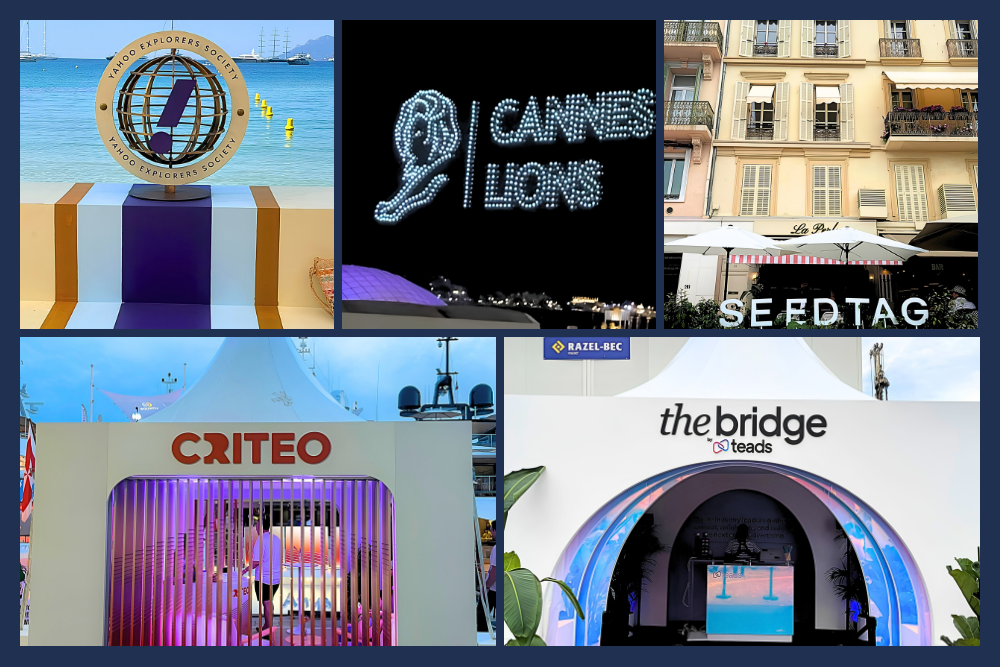
Cannes Lions has changed. Walk the Croisette today and you will notice fewer creatives, fewer marketers unless they are on a stage being courted to spend. What you will find, everywhere outside the Palais, is AdTech. As Jameson Fleming, Editorial Director at MM+M and Campaign US, observed, Cannes increasingly resembles an AdTech conference as much as a creativity festival. The conversations beyond the Palais reflected where investment is flowing – towards AI, creator platforms, commerce media and marketing technology.
Members of Renovata’s AdTech practice, Mannie Gill, Alan Fecamp, and Carlos Fernandes, were there across the week. Here is what stood out this year.
“Robots don’t build brands. You do”
Marc Pritchard, Chief Brand Officer at P&G, opened with the most clarifying statement of the week. Technology can accelerate execution. But creativity has always been, and always will be, a deeply human endeavour.
It sounds simple. But it carries real weight in a moment when boards are asking whether they need fewer senior leaders and more tooling. The companies that win over the next decade will not be the ones that automate the most. They will be the ones that use technology to free their best people to do the work only humans can do: build trust, make creative bets, and lead through uncertainty.
Boards increasingly want leaders who understand AI without being defined by it. The CMO or CPO who brings genuine creative ambition and uses technology as a multiplier is a fundamentally different hire from one who defaults to efficiency. That distinction is becoming one of the most important calls a CEO makes.
AI is overhyped today. And wildly underestimated over the next 15 years
Demis Hassabis, Co-founder and CEO of Google DeepMind, framed it better than most. The short-term hype is real – a lot is promised and less is delivered immediately. But the transformation coming over the next 10 to 15 years is something most organisations are not planning for seriously enough. Speaking to Bloomberg’s Francine Lacqua he said, “AI may be overhyped in the near term, but underappreciated over the next decade”, calling it a “new human era” – not one where humans are replaced, but one where the human capabilities that matter most become dramatically more valuable.
For CEOs, the implication is not that you need to act faster. It is that you need to plan for a longer horizon than the hype cycle demands. The businesses that come out ahead will be building leadership teams capable of adapting continuously – not ones that hired around a particular tool set in 2025 and 2026.
Plan for the decade, not the hype cycle. Back teams that keep learning over any single tool. Hire adaptability as the core leadership trait – not familiarity with today’s stack.
Your CEO is now part of the company’s value proposition
This was the most data-backed shift at Cannes this year, and it has direct implications for how boards think about executive hiring.
Media intelligence firm CARMA analysed international coverage of Cannes Lions 2026 and found that CEOs and founders each appeared in 34% of articles – combined, business leaders drove 68% of all media coverage from the festival. Chief marketing officers, despite Cannes being the world’s premier marketing event, appeared in just 20% of stories. Director-level executives accounted for 2%.
The story of Cannes 2026 was told by chief executives, not marketing functions.
That is not a PR observation. It is a signal about how companies are now judged. CARMA’s analysis found that the findings suggest Cannes is increasingly being covered as a boardroom conversation centred on business transformation, technology and growth rather than as a marketing function discussion.
The gap between CMO attendance and media visibility may represent an untapped communications opportunity — or it may signal that chief executives are becoming the primary storytellers of modern brand building.
Brand is no longer defined by logos or campaigns. Customers, investors and employees increasingly judge a company through the visibility, credibility and judgement of its leaders. The question is not whether your CEO should have a public voice. It is whether they build trust every time they use it.
The implication for hiring is clear. Executive presence is becoming a strategic capability, not a communications skill. The leaders who can build confidence with customers, talent and investors – not just run the business – are the ones boards should be prioritising.
Your next executive hire is not just leading the company. They are shaping how the company is valued. That is a higher bar than it was five years ago, and it belongs on the brief from day one.
Stop using AI to cut. Start using it to create
McKinsey’s research at Cannes pointed to a broader shift in how leading organisations think about AI. Rather than focusing only on productivity and efficiency, they are redesigning how growth happens – using AI to create new customer experiences, new ways of working and new sources of value, not simply lower costs.
Most organisations are still early in that transition. While AI adoption is widespread, relatively few businesses have fundamentally redesigned their operating models around it.
That changes what businesses need from their leaders. Companies increasingly need executives who can combine commercial judgement, product thinking and AI fluency to rethink how value is created. Competitive advantage won’t come from adopting AI first. It will come from building organisations – and leadership teams – that know what to do with it.
The advantage was never the technology. It is the talent that connects it all
Michael Shaughnessy, COO at Kargo, put the commercial reality plainly: “The people that will succeed in the future of media will be those that understand how to connect AI with creators, with commerce and premium media.” His point reflected a broader theme across Cannes: competitive advantage increasingly comes from connecting technology, creativity and commercial execution rather than treating them as separate disciplines.
One theme connected conversations across the week. AI does not replace people. It raises the value of the human capabilities great leaders bring: creativity, trust, judgement and adaptability.
These are not soft skills. In an AI era, they become competitive advantages. Again and again, speakers returned to the idea that as AI becomes more capable, human judgement, creativity and the ability to connect technology with people become even more valuable.
Your edge this decade will not come from having better AI. It will come from whether you can hire, develop and back the leaders who know how to turn it into commercial advantage. That’s a talent strategy issue, and it belongs on the board agenda – not treated as an HR initiative.
From Cannes to the boardroom
Cannes Lions 2026 was not primarily a creativity festival. It was a signal. The convergence of AdTech, AI, and brand on a single stage reflects a broader convergence happening inside every media, commerce, and technology business: the organisational lines between product, data, commercial, and creative are dissolving.
The leaders who will create the most value over the next five years will be the ones who can operate across those lines – who bring creative ambition, commercial instinct, and the ability to build organisations that learn faster than the market changes around them.
Renovata has worked with leading AdTech businesses including Teads and Criteo, placing over 200 board and senior leaders across the ecosystem. If you are thinking about a leadership change, get in touch. We would welcome the conversation.
Mannie Gill, Co-founder, Partner
mannie.gill@renovata.com
Alan Fecamp, Partner
alan.fecamp@renovata.com
Carlos Fernandes, Partner
cfernandes@cribb.de