
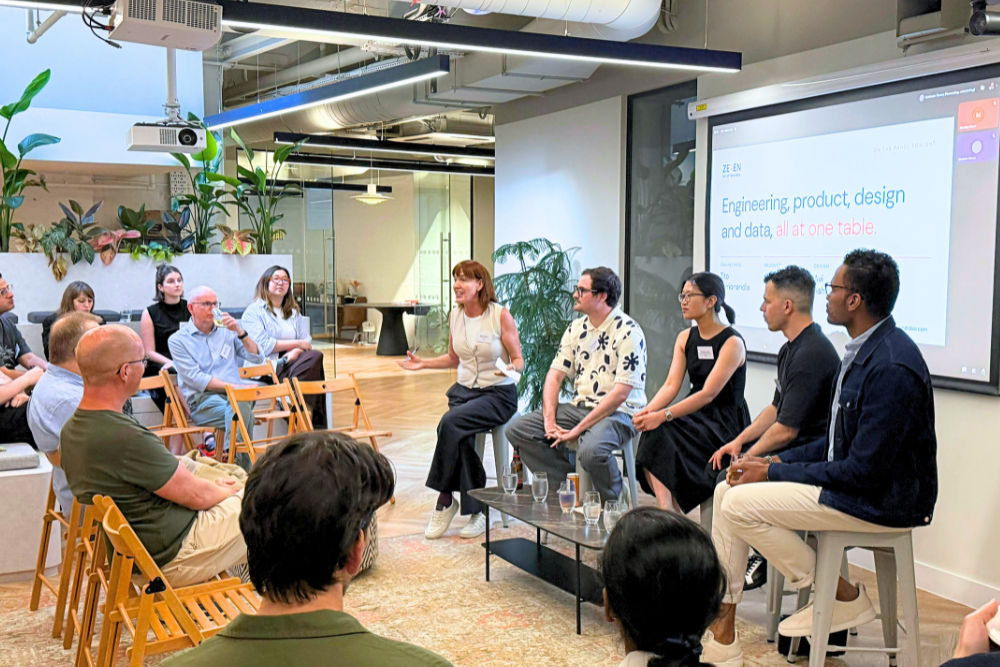
AI hasn’t changed what product, engineering, data and design teams are trying to achieve. It’s changed how the work moves between them, and how clearly the lines of ownership hold up. That was the question at the centre of Dissolving Disciplines: Product, Engineering, Data & Design After AI, an event hosted by Zeren in partnership with Encord, held in Covent Garden for senior leaders from VC and PE-backed businesses.
At a glance
- Leaders in the room expect their R&D functions to grow, not shrink, and to manage rising cost throughput.
- AI is absorbing solved, repeatable problems. Contextual judgement remains the crucial human function.
- Design headcount is being questioned again inside several businesses, with consumer software leaders best placed to defend it.
- Accountability, not capability, is the harder open question when AI agents ship work directly.
- Hiring criteria are shifting toward judgement and AI fluency, even mid-search.
About the event
The evening combined a moderated panel discussion with facilitated breakout tables. Attendees were C-suite, SVP, VP and Director-level leaders across Product, Engineering, Data and Design, alongside founders and senior hiring leaders from VC and PE-backed businesses. The panel was moderated by Julia Barber, Director at Renovata, and included:
- Christine Siu, SVP Product at SoSafe
- Tito Sarrionandia, Head of Engineering at Jigsaw
- Avi Ashkenazi, Senior Director of Product Design at Deel
- Jed Francis, entrepreneur and data scientist, founder of The Shipyard and Hairouna Labs
What came up in our panel discussion
Every panellist arrived at the same problem from a different direction, but there was one overarching conclusion: AI has closed off the places where weak decisions used to hide.
“Category creation and disrupting ourselves” was how Christine Siu, SVP Product at SoSafe, framed the task now facing product leaders. Getting there, she argued, takes an organisation willing to let people tread on each other’s toes rather than sit inside neat, siloed functions. Whether that’s scalable, or just a recipe for too many strong personalities pulling in different directions, was the question she left open for the room.
That same tension between speed and restraint carried into Tito Sarrionandia’s contribution. The Head of Engineering at Jigsaw pointed out that capability isn’t really the constraint anymore. His own team can already prototype ideas rather than just describe them, using AI tools to weigh into design conversations directly. What matters now, in his view, comes down to judgement: “if you could ship everything tomorrow, would you?”
Judgement was also the thread running through Jed Francis’s contribution, though he took the longer view. The entrepreneur and data scientist, founder of The Shipyard and Hairouna Labs, placed the moment in a wider arc: this kind of disruption, he said, is a cycle the industry has lived through before, one that tends to come back around. For him, AI’s real impact won’t be speed for its own sake, but far deeper cross-functional working, shipping faster than even the “Spotify model” of autonomous squads managed a decade ago.
Experimentation rounded out the discussion, an angle Avi Ashkenazi, Senior Director of Product Design at Deel, brought to the table, echoing a theme that ran through the whole panel: design and product leadership under AI increasingly means testing more and committing less, before certainty arrives.
From there, the panel turned to questions nobody in the room had fully resolved. Will engineering teams accept shipping code that isn’t fully tested? Can security and testing practices keep pace with rising output? Will climbing token costs push teams back toward open-source tooling? One answer ran against the grain of the wider industry narrative: several leaders expect their R&D functions to grow, not shrink, simply to manage the demands of higher throughput.
Beyond the panel: what we surfaced in the breakout sessions
Breakout conversations ran across multiple tables in parallel. To protect the confidentiality of individual contributions, the insights below aren’t attributed to any specific attendee.
Design headcount is being questioned again
Several tables reported live internal conversations about whether design teams need to be as large as they are. One recurring response was to return to first principles and rearticulate design’s value to stakeholders directly. In consumer software specifically, the case is easier to make, since experience quality remains a clear competitive differentiator.
AI resolves solved problems. It doesn’t yet replace judgement
Teams described handing well-understood problems, such as authentication or standard checkout flows, to product and engineering to execute independently using AI tooling, freeing design capacity for unsolved problems. The limits of this approach came through clearly in one example: a search component that worked perfectly in isolation but failed once placed in context, because the judgement about when search should be prominent versus invisible couldn’t be automated.
Misapplied AI has a real cost
One example shared was a task that took eight hours using AI, where the equivalent manual build in Figma would have taken thirty minutes. It’s a small story, but it makes a real point: AI acceleration isn’t uniform across tasks, and picking the wrong one to automate can cost more time than it saves.
Engineering resistance is real, and only partly about code quality
Some pushback against AI-generated code reflects legitimate concern about technical foundations. Some of it is simply concern about job displacement. The response favoured across tables wasn’t to force the issue, but to build guardrails, linting rules and stronger prompt infrastructure, treating it as an engineering problem to solve rather than a position to argue past.
There’s no settled view on junior talent
This was the theme with the widest range of opinion. Senior leaders can set guardrails for AI-assisted work, but junior team members often don’t yet have the experience to judge when AI has got it wrong. Design and engineering have both historically worked as apprenticeships, where judgement develops through exposure and failure. There’s genuine uncertainty about what AI-assisted workflows are doing to that experience curve. Despite this, graduate hiring didn’t appear to be slowing. At least one hiring process shifted its criteria mid-search, prioritising AI fluency as a bridge skill over traditional process experience.
Accountability is a harder question than capability
Discussion returned repeatedly to who’s responsible when an AI agent, or a leader who directed one informally, ships work that fails. One comparison offered across tables stuck: deploying an agent is closer to taking responsibility for a child than owning a tool, since the agent acts using the deployer’s authority and permissions. That opened further, unresolved questions about incentive structures, and what “mission critical” should even mean as cycle times compress.
Collaboration is strengthening, not weakening
Several tables reported that AI is increasing the need for collaboration rather than reducing it, since it can typically solve part of a problem but rarely finishes it end to end. Curiosity came up repeatedly as the most valued trait, alongside a combination of ambition and scepticism, holding enough conviction to move quickly while staying sharp enough to avoid what one table called “a rabbit warren of bad ideas.
What this means for team structure and hiring
The room didn’t converge on smaller teams or flatter structures as an inevitable outcome. If anything, the opposite view was more common: several leaders expect R&D functions to expand to manage rising throughput, with a shared expectation that businesses cutting internal teams too aggressively will regret it. What’s changing isn’t headcount. It’s the profile of who gets hired.
Across both the panel and the breakout tables, the consistent position was that AI raises the value of judgement and curiosity rather than reducing it, alongside the ability to work across boundaries that used to be fixed. The “T-shaped” hiring model came up repeatedly as outdated, replaced by a wider, less uniform range of overlapping skill profiles. For leaders building product, engineering, data and design teams through this shift, the hiring brief is moving away from filling clearly defined seats and toward finding people who can operate under ambiguity, exercise judgement without established precedent, and work across disciplines with less fixed boundaries than before.
Frequently asked questions
What was Zeren’s “Dissolving Disciplines” event about?
A panel and breakout discussion for senior Product, Engineering, Data and Design leaders from VC and PE-backed businesses, examining how AI is changing team structure, hiring and ownership across those functions.
Who spoke on the panel?
Christine Siu (SVP Product, SoSafe), Tito Sarrionandia (Head of Engineering, Jigsaw), Avi Ashkenazi (Senior Director of Product Design, Deel) and Jed Francis (entrepreneur and data scientist, founder of The Shipyard and Hairouna Labs). Julia Barber, Director at Renovata, moderated.
Is AI reducing the need for specialist designers and engineers?
Not according to attendees. AI is absorbing solved, repeatable problems, but contextual judgement, particularly around user experience and product decisions, was consistently described as something AI doesn’t yet replicate.
Are companies planning to shrink their product and engineering teams?
The prevailing view was the opposite. Several leaders expect R&D functions to grow to handle rising throughput, with a shared expectation that businesses cutting internal teams too quickly will regret it.
How is AI changing what leaders look for when hiring product and engineering talent?
Discussion at the event pointed toward hiring criteria moving away from narrow specialist experience and the traditional “T-shaped” profile, toward judgement, curiosity and comfort working across disciplines. At least one leader described switching their search criteria mid-process to prioritise AI fluency as a bridge skill.
Who is accountable when an AI agent makes a mistake?
This was raised as one of the harder open questions at the event. The view shared across breakout tables was that responsibility sits with the person who deployed the agent, since it acts using that person’s authority and permissions, a comparison one attendee likened to taking responsibility for a child rather than simply owning a tool.
What is the Renovata Events Programme?
The Renovata Events Programme exists to build engagement within our network and deepen relationships with our clients, candidates and partners. Get in touch with Julia Barber if you’d like to be involved as a partner, speaker or guest.
Who hosted this event?
This event was hosted by Zeren, part of Renovata’s Product, Tech and Design practice, and co-hosted by Encord. Zeren’s Product, Tech and Design practice focuses on hiring Product, Engineering, Data and Design leaders and building out teams for VC and PE-backed businesses. To discuss a hiring need in this space, contact:
Paul Nicholls, Director, Product & Tech Search
paul.nicholls@zerenglobal.com
Kim Wardle, Director, Product Design Search
kim.wardle@zerenglobal.com
Bryonny Barton, Director, Product & Engineering Search
bryonny.barton@zerenglobal.com